
Lumbar Annular Closure Devices | Prevent Recurrent Disc Herniation
Reduce the Risk of Recurrent Disc Herniation
Lumbar annular closure devices are designed to help reduce the risk of reherniation following discectomy in select patients with larger annular defects.
What Are Lumbar Annular Closure Devices?
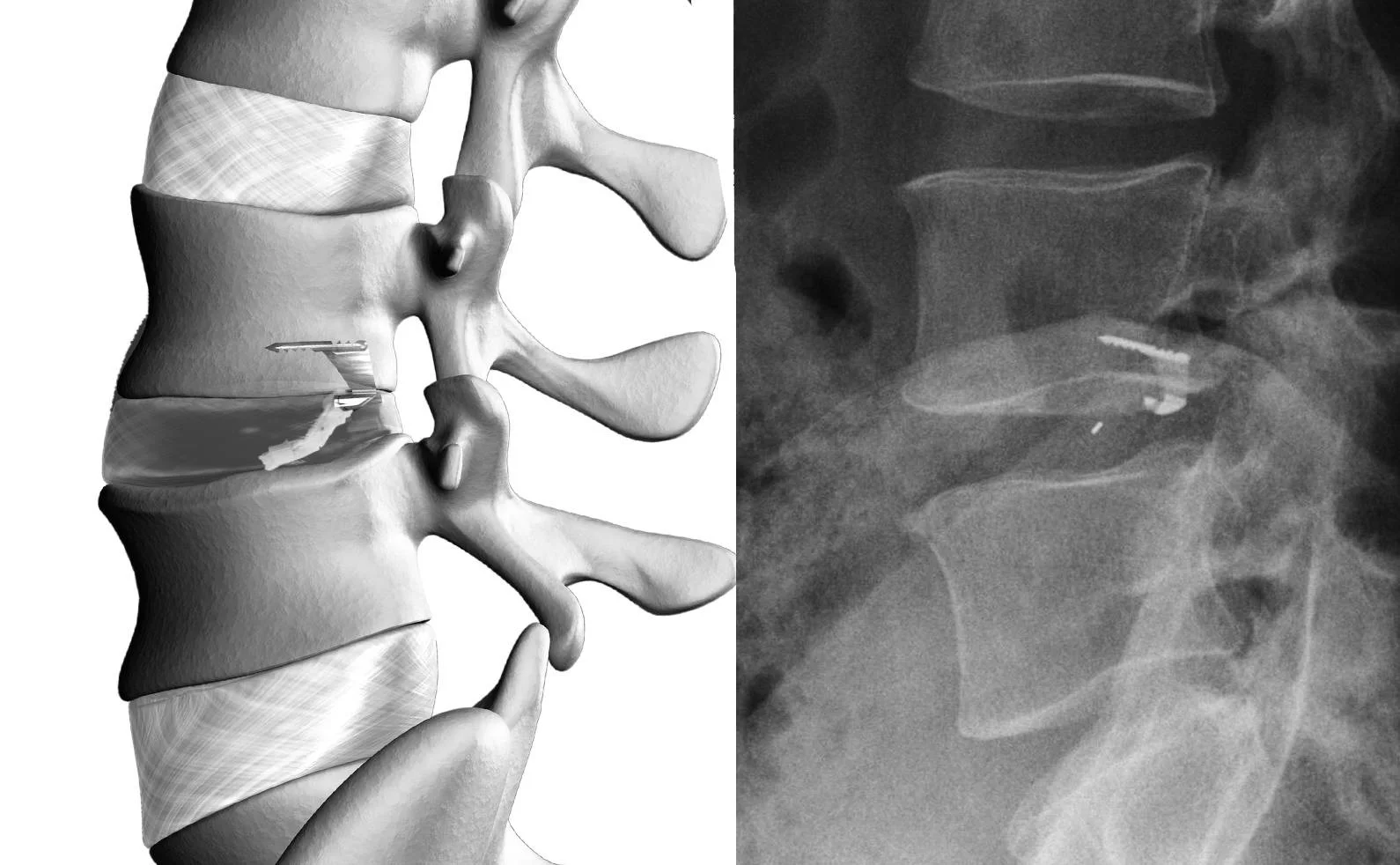
Lumbar annular closure devices are surgical implants used during lumbar discectomy to help reduce the risk of recurrent disc herniation. After a disc herniation is removed, a defect remains in the outer layer of the disc (annulus). In certain patients, particularly those with larger defects, this can increase the likelihood of the disc herniating again.
Annular closure devices are designed to help close or protect this defect and contain the remaining disc material. One example of this type of technology is the Barricaid annular closure device.
Why Is This Important?
One of the biggest concerns after a lumbar discectomy is the risk of reherniation.
Patients with larger annular defects have a higher risk of recurrence, which can lead to:
- Return of leg pain (sciatica)
- Additional procedures or repeat surgery
- Prolonged recovery
Annular closure devices may help reduce this risk in appropriately selected patients.
How Do They Work?
These devices typically consist of a small anchor that attaches to the vertebral body and a flexible mesh or barrier that covers the annular defect.
This creates a protective barrier that:
- Helps contain the remaining disc material
- Reduces the chance of reherniation
- Preserves motion at that spinal level
They are placed at the time of the initial discectomy procedure.
Who Is a Candidate?
You may be a candidate if:
- You are undergoing a lumbar discectomy
- You have a large annular defect identified during surgery
- You are at higher risk for recurrent disc herniation
Not all patients are candidates. Final determination is often made intraoperatively based on defect size and disc condition.
Benefits
- Reduced risk of recurrent disc herniation
- Lower likelihood of needing repeat surgery
- Maintains natural motion (no fusion required)
- Added protection in higher-risk patients
Discectomy Alone vs. Discectomy with Annular Closure
Discectomy Alone:
- Effective for relieving nerve compression
- Higher recurrence risk in large annular defects
Discectomy + Annular Closure Device:
- Addresses nerve compression
- Adds protection against reherniation
- May reduce reoperation rates
FAQ
Are annular closure devices FDA approved?
Yes, certain devices (including Barricaid) are FDA approved for use in specific patients following lumbar discectomy.
Will I feel the device?
No, patients do not feel the device once it is implanted.
Does this replace spinal fusion?
No, this is not a fusion procedure. It is used to preserve motion and reduce recurrence risk.
What is recovery like?
Recovery is similar to a standard lumbar discectomy.
Is this used in every discectomy?
No, it is only used in select patients who meet criteria.
Surgeon Perspective
As a board-certified orthopedic spine surgeon, I evaluate each patient individually and assess intraoperative findings to determine whether an annular closure device is appropriate. Patient selection is critical, and this technology is used only when it is expected to provide meaningful benefit.
If you have been diagnosed with a lumbar disc herniation or are considering surgery, schedule a consultation to determine if you are a candidate for annular closure.